
Today's news from the 2010 APACRS annual meeting brought to you by EyeWorld magazine.
FUSION 2010 opens with a BANG!

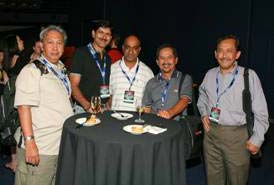
Members of the APACRS and AUSCRS enjoy cocktails in the exhibit hall immediately prior to the opening of FUSION 2010
Taking a firm stance against standing on ceremony, the APACRS and AUSCRS opened their joint 2010 meeting with an entertainment extravaganza that showcased a fusion not just of the numerous cultures of the Asian and Australasian regions, but of high art and pop culture, mixing the traditional with the modern, class with crass.
Attendees were welcomed by the haunting voice of aboriginal opera singer Deborah Cheetham, singing to the accompaniment of Australian aboriginal percussions and world-inflected electronica. She was joined by Australian pop singer Cosima De Vito in a moving duet that celebrated the multiplicitous origins of Australia—aborigine and colonialist, convict, prisoner and hopeful migrant alike.
The first half of the program was narrated by 13-year-old Australian girl Tiarne, telling the story of the fusion of cultures that forms the rich backdrop of the region, establishing the tone for the APACRS-AUSCRS meeting. The show featured performances by the Hua e Wha Mo Li Hua (The Fantail of the Wind) Maori Dancers, the Mo Li Hua traditional Chinese Dancers, a Taiko drummer combining Japanese traditional and modern percussion styles, Koto player Yayoi, and a Bollywood Dance Troupe.
At the end of the first half, the proceedings were briefly interrupted by APACRS and AUSCRS President Graham Barrett, who laid down the three rules of the meeting: take the learning seriously; have fun; and NO TIES.
For the second half of the Fusion 2010 opening show, Dr. Barrett decided that the ophthalmologists themselves should have a turn at letting their hair down. Standing in for celebrity icons Simon Cowell, Randy Jackson and Cara Dioguardi (or Paula Abdul, take your pick), Dr. Barrett, Con Moshegov and Ms. De Vito judged their own version of Idol, cheekily dubbed Eye-dol, hosted by Ryan Seacrest stand-in Tim, the meeting's "creative director".
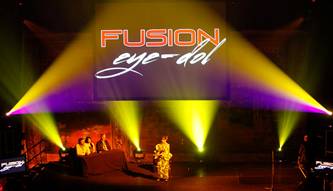
Dr. Hiroko Bissen-Miyajima performs a Japanese folksong for Fusion eye-dol
After an arduous, video-taped audition process that eliminated internet sensations similar to William Hung and Ken Lee (among others), Eye-dol featured performances by Drs. Sara Booth Mason, Hiroko Bissen-Miyajima and a duet by Drs. Adrian and Li-An Koh. All three performances won the affection of the judges. All the "eye-dols" were awarded "proper" leather bush hats.
Ms. Cheetham then returned for a rousing operatic send-off.
Unable to completely escape the tradition of making speeches, Dr. Barrett said the show was just the start, and bid attendees to "keep up the spirit". The FUSION 2010 opening extravaganza was held at Hall 2 of the Cairns Convention Centre in Cairns, Australia. The meeting will run at the Convention Centre from 1 to 4 July 2010.
Learning from the masters
The Fusion 2010 meeting premiered a new MasterClass Series for members of both the APACRS and AUSCRS. Each Master Class is an interactive lecture session that gives participants the chance to learn directly from some of the world's best practitioners. Limiting each session to about 20 participants gives each participant a better chance to ask all the questions they ever wanted to ask the experts on hand, keeping the sessions dynamic and wholly interactive.
Five Master Classes were held on 1 July 2010, preceding the official opening of Fusion 2010: Intacs and Kerarings, with Colin Chan, MD, and Jose Güell, MD; Collagen cross-linking in corneal disease, with Grant Snibson, MD, R. Doyle Stulting, MD, John Males, MD, and Lim Li, MD; Wobbly cataracts and subluxated/dislocated IOLs, with Alan Crandall, MD, Soon Phaik Chee, MD, and Ronald Yeoh, MD; Perspectives on pterygium, with Lawrie Hirst, MD, and Donald Tan, MD; and Improved outcomes after cataract surgery, with Woflgang Haigis, MD, and Fam Han Bor, MD.
Trinity sessions
On June 30, 2010, a contingent of cataract and refractive surgeons from all over the world gathered for the first of a series of industry-sponsored symposiums prefacing the Fusion 2010 combined meeting of the APACRS and AUSCRS. Held at the Trinity conference room of the Shangri-La Hotel in Cairns, Australia, the Abbott Medical Optics (AMO, Santa Ana, Calif., USA) satellite symposium consisted of two sessions, with each session consisting of three lectures covering the latest in refractive and cataract surgery.
The refractive session comprised an extensive discussion of the latest in laser refractive surgery, beginning with an overview of wavefront applications—including an introduction to AMO's iLASIK and CustomVue procedures—presented by AMO Senior Product Marketing Manager Daniel Carr. Capt. (ret) Steven C. Schallhorn, MD, followed with a comprehensive discussion of why he believed iLASIK is the procedure of choice for refractive surgery, with particular emphasis on a study he conducted in an attempt to quantify patient satisfaction--what he called a "new frontier" for refractive surgeons.
Apart from providing an interesting perspective on the relationship between surgeon, procedure and patient, the findings of the study serve as further evidence for Dr. Schallhorn's initial thesis, in that the superior visual outcomes achieved with the iLASIK procedure are a major factor in patient satisfaction.
Roger Steinert, MD, rounded out the session with a discussion of IntraLase Enabled Keratoplasty (IEK), a.k.a. femtosecond laser corneal transplantation. The femtosecond laser, said Dr. Steinert, achieves better incision integrity with a greater surface area for contact between donor and host tissues, while minimizing induced astigmatism.
Gerd Auffarth, MD, kicked off the cataract session with a discussion of presbyopia treatment—an important topic, he said, because, eventually, "everybody becomes presbyopic." Focusing on IOL-based treatments, Dr. Auffarth concluded with his experience with the Synchrony lens. In his experience, he said, the accommodating lens does in fact work as designed, i.e., translating the contraction of the ciliary muscles into changes in the distance between the Synchrony's anterior and posterior lenses. Moreover, he said, this mechanism does in fact provide about 2 D of accommodation.
In the second lecture of the session, Martin A. Mainster, MD, presented a meticulously constructed argument against blue light filtration. Although he was the first to hypothesize that blue light exposure may be harmful to the macula—in a scientific paper he published back in 1978—the hypothesis, he said, has not stood up to the test of science. It isn't just that more than 30 years of scientific study has failed to provide convincing evidence for a clinically meaningful protective effect; more importantly, studies conducted by Dr. Mainster and his colleague and long-time partner Patricia L. Turner, MD, have shown that blue light filtration actually has detrimental effects not only on vision, but on general/systemic health as well, by adversely affecting circadian performance.
Finally, Dr. Steinert returned to the stage with an overview of new phaco technology, focusing on AMO's Ellips FX, Fusion Pump, and Fusion Fluidics. The best thing about the Whitestar Signature System which comprises these technologies, he said, is that it is supremely flexible—rather than imposing a particular technique or approach, the system allows cataract surgeons to find the combination of techniques and technologies they feel most comfortable with. AMO's refractive and cataract sessions were moderated by Con Moshegov, MD, and Daniel Black, MD, respectively.
MICSing it up
The Stellaris (Bausch + Lomb, B+L, Rochester, N.Y., USA) is a "unique machine", said Terence Devine, MD. The phaco machine, he said, was designed from the ground up to go from 2.8- to 1.8-mm incisions. Microincision cataract surgery, said Dr. Devine, poses three main challenges.
The first challenge is maintaining chamber stability. The Stellaris addresses this problem by using a special pump, wider infusion tubes, and a computer algorithm called proportional integral differential (PID).
The second challenge is optimizing phaco energy. The Stellaris, said Dr. Devine, increases the longitudinal stroke of the tip by 25% compared with the old Millennium system (50% compared with other longitudinal phaco machines); in addition, Dr. Devine challenged the notion that the backstroke of longitudinal phaco is wasteful, generating heat and energy without helping fragment and/or emulsify the cataract nucleus. In fact, he said, studies such as one conducted by his colleague, Mark Schafer, MD, have shown that the cavitation effect during the backstroke contributes to phacoemulsification, such that the effect reduces the power requirement threefold.
The final challenge is thermal safety. In recent years, non-longitudinal phaco has curried favor from surgeons by claiming to reduce the generation of "waste" heat; Drs. Devine and Schafer, however, conducted infrared studies that revealed that heat generation with a longitudinal phacotip occurs at the hub, which does not come into contact with living tissue. On the other hand, nonlongitudinal phaco tips generate heatspikes along the shaft, creating a risk for incision burn. His findings are backed by global statistics that associate the highest rates of incision burn with non-longitudinal phacotips.
Dr. Devine talked about Stellaris at a breakfast symposium sponsored by B+L, held on 1 July 2010 at the Cairns Convention Centre. Joining Dr. Devine were Mohan Rajan, MD, lecturing on the use of S-MICS in high volume cataract surgery practice in India, and Mark Perks, MD and Michael Lawless, MD, discussing their experiences using the Crystalens (B+L) in their general ophthalmic and refractive specialty practices, respectively.The symposium was moderated by Peter Heiner, MD.
Dangerous curves
 |
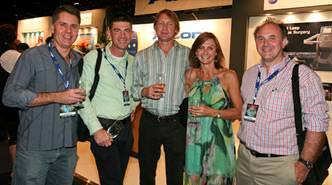 |
| The APACRS and AUSCRS come together for FUSION 2010 |
|
Curvature maps are not reliable for diagnosing keratoconus, said Michael Belin, MD. Curvature maps, he said, assume a "Gullstrand reduced eye", a model designed for geometric—as opposed to clinical—optics. Dr. Belin talked about the diagnosis of corneal conditions using pachymetry and introduced the new Belin/Ambrosio Enhanced Ectasia Display—which he helped develop, together with Renato Ambrosio, Jr, MD—at a Pentacam workshop sponsored by Oculus, held on 1 July 2010 at the Cairns Convention Centre.
Eyes with keratoconus can look perfectly normal by curvature, said Dr. Belin; surgeons should instead base diagnosis on measurement of anterior and posterior elevation, and the spacial relationship between the two. However, “raw” elevation maps aren't very useful for rapid visual inspection, Dr. Belin said. The diagnosis of keratoconus requires pattern recognition, and raw elevation maps don't show much of a difference between normal and pathological corneas. Instead, elevation maps, as with the new Belin/Ambrosio Enhanced Ectasia Display, are presented in reference to a best fit sphere derived from the central 8 mm of the cornea.
Post-LASIK ectasia presents a different problem; because the anterior surface has been modified by previous surgery, anterior elevation can no longer be relied on for diagnosing corneal conditions. Instead, said Dr. Belin, surgeons have to rely on measurements of the posterior surface, which refractive surgery leaves untouched.
Dropping the showbag
"We need to get updated as often as we can," said Abhay Vasavada, MD, voicing the rationale behind the OMT sessions, sponsored by Alcon (Fort Worth, Texas, USA/Hünenberg, Switzerland). The latest, the TropSat session moderated by Dr. Vasavada, was held in prelude to the Fusion 2010 meeting that opened later that day. The session, said Dr. Vasavada, featured a set of topics that all ophthalmologists, regardless of specialty field, "can relate to".
For instance, the first topic was the art—or, rather, the science, as lecturer Colin Chan, MD, said it should be—of choosing artificial tears. This is a concern for all ophthalmologists, including those in cataract and refractive surgery, since a "poor tear film", regardless of outcomes in terms of visual acuity, leads to unhappy patients with poor quality vision.
Ophthalmologists, said Dr. Chan, tend towards the unfortunate practice of the "showbag technique" for prescribing artificial tears—i.e., simply dumping different artificial tear products on patients and asking them to use whichever works for them. Dr. Chan reduced the “science” to two simple steps.
Step 1, grade the severity. All you need to do, said Dr. Chan, is ask your patient about blurred vision. If they complain of blurred vision, there's no need to do all the tests for dry eye. Simply check the tear breakup time (TBUT).
Step 2, selecting the artificial tear product, requires a little more thought. Simply check the product label. The ideal artificial tear, said Dr. Chan, contains electrolytes, is hypoosmotic, hyperoncotic, viscous, and has a way to repair glycocalyx mucin/epithelial cell loss.
Dr. Chan later returned to talk about the past, present and future of Alcon's WaveLight Allegretto system. At the end of his lecture, he gave attendees a glimpse of what Alcon has in store for the near future, including a new 200kHz femtosecond laser capable of cutting flaps in 10 seconds, and a new excimer laser that allows integration with the new femtosecond laser and diagnostic equipment to create a complete Refractive Suite.
Also speaking at the session were John Kearney, MD, who introduced the brinzolamide 1%/timolol 0.5% fixed combination AZARGA (Alcon), a more comfortable alternative to drugs like Cosopt; Paul McCartney, MD, who talked about the OZil IP (Alcon), which introduces brief pulses of longitudinal phaco when the tip occludes; Patrick Versace, MD, who talked about the need for phakic IOLs, specifically Alcon's Cachet; and Mark Troski, MD, who told attendees exactly why they should “bother” with premium IOLs.
The Alcon OMT TropSat was held on 1 July 2010 at the Cairns Convention Centre in Cairns, Australia.